
|
|
|
| | |
|
| |
| | |
|
|

|
|
| | |
|

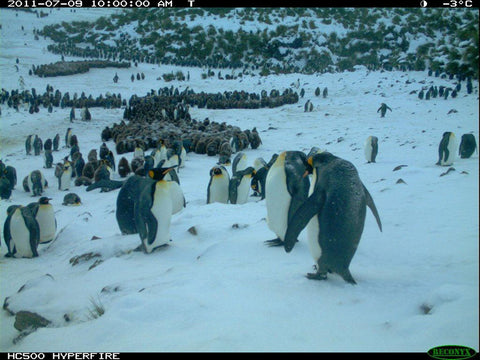
Photo courtesy of: Bióloga Verónica Andrea Quiroga
CONICET - Instituto de Ecología Regional (IER)
Camera Traps For Researchers
By: The TrailCamPro Staff
All over the world, Research Scientists are discovering camera traps as a way of enhancing their research projects. Putting camera traps in the middle of a desert, jungle, savannah, mountain, etc. will quickly help you create an "inventory" of the species in that particular ecosystem. Not only that, but you will be able to track and identify animals 24 hours a day, 7 days a week, 365 days a year in the most remote locations with very minimal maintenance and/or supervision.
Many researchers find camera traps greatly reduce the amount of "legwork" required to observe some of the most elusive species alive.

Snow Leopard - Mongolia
Courtesy of: Dr. Tom McCarthey
So what goes into knowing which camera trap is best for your project? There are many variables. One of the first questions we always ask is "What kind of situation will you be putting the camera trap in? Will it be over a game trail? A watering hole? A bait station?"
Knowing the answers to these basic questions helps to narrow down the options. For instance, if you are placing a camera trap on a bait station, you are already assuming the animal will eventually be at the bait. More than likely you will set the bait in the center of the picture. Presumably, the animal will be at the bait station for a extended amount of time and will be somewhat stationary during this time. For a situation such as this, a trail camera with a narrow detection zone and slow trigger speed is not a bad thing.
On the other hand, if you place a camera trap on a game trail - where animals will be moving somewhat briskly and will definitely NOT be stationary - you will need a camera trap that not only triggers quickly and has a wide detection zone, but also is able to take multiple pictures of that particular species as it walks by.
Here are a few links to help you understand the relationship between trigger speeds and detection zones:
Trigger Speeds
Detection Zone Test
Now, to put both detection zones and trigger speeds together, check out the 2009 Trail Camera Shootout
Another thing to consider would be the size of the camera trap. Some trail cameras can be 4-6 lbs (or more with batteries) and up to 10" tall x 6" wide. If you will be trekking off into the distance, you would only be able to carry 2-3 in a backpack at a time.
On the flip-side, some cameras are smaller than the size of your hand and may only weigh a few pounds! You could easily fit a dozen into a backpack!

Moultrie I60 vs. Bushnell Trophy Cam

Moultrie I60 vs. Bushnell Trophy Cam/Size Comparison
How do camera traps do in severe weather? Every camera trap that we carry and/or review is considered weatherproof. However, none of the cameras are waterproof. Waterproof means you could dunk a camera under water for a certain amount of time and it would be unaffected. Weatherproof means that under normal weather patterns (i.e. heavy tropical storms, snow, desert climates and etc.) it will continue to operate correctly.
One game camera to take note of is the Scoutguard SG550. The case on the SG550 is not sealed. The bottom cover does not have a rubber seal and in extreme high humidity areas, moisture could eventually damage the camera.
Most trail cameras will operate to about 0-10° F. Reconyx is the lone exception. Reconyx camera traps will operate at -40° F. I feel for the scientists that have to be in that weather!
What does a good camera trap cost? Great question! Unfortunately, there is no clear-cut answer. Most camera traps range anywhere from $100 - $650. There is an increasing number of quality trail cameras at the $200 range. If you want the highest quality possible, consider a Reconyx camera trap, they range from $450 - $550.
As an added bonus, we offer quantity discounts on orders of 5 or more cameras. If you ever have a question regarding pricing, shipping, availability or discounts, feel free to call us at 1-800-791-0660 - or email at info@trailcampro.com. Or click "Request Quote" below!
Does Trailcampro ship internationally? We have shipped to just about every country out there (only a slight exaggeration), and we have an experienced international shipping manager that will help you find the most affordable and insured shipping method available.
Leopard eating an Eland - Kenya
Anthony Childs - Stealth Cam
Since we do ship internationally quite frequently, we have acquired several nice discounts from FedEx that we pass on to our customers. Feel free to call or email for a full international shipping quote!
Western Grey Kangaroo - Australia
Mick Davis/DEC - Moultrie I60
What about Manufacturer Warranties? Most Camera Trap companies offer a one year warranty against defect. Bushnell offers a two year warranty.
I would highly suggest visiting our Trail Camera Selection Guide page. It will take you through a step-by-step process of choosing the benefits that you need and matching it to the camera trap that is right for you.
In the meantime, here are some of the camera traps and accessories that researchers have had great success with.
Price: $549.95
Reconyx Hyperfire HC600
The Reconyx Hyperfire HC600 is a brand new camera trap. We have not finished the full review but initial observations have me thinking of the word "perfect." Programming was a breeze, picture quality is unbelievable and believe it or not - it may be faster then previous Reconyx models!
The HC600 is the completely covert model. It has no visible infrared flash at night. You can use up to a 32 gig SD card. Camera uses 12 AA batteries (Tenergy Nimh batteries recommended).
Look for the full review soon!
Price: $449.95
Reconyx Hyperfire HC500
The Reconyx Hyperfire HC500 is
a brand new camera trap. We have not finished the full review but
initial observations have me thinking of the word "perfect."
Programming was a breeze, picture quality is unbelievable and believe
it or not - it may be faster then previous Reconyx models!
The HC500 is a red flash infrared camera. The red flash is very faint and hard to notice unless you're looking directly at the camera. You can use up to a 32 gig SD card. Camera
uses 12 AA batteries (Tenergy Nimh batteries recommended).
Look for the full review soon!
Price: $199.95

Bushnell Trophy Cam
The Bushnell Trophy Cam camera trap is very similar to the Scoutguard (see above) with a few added benefits. It is also a very compact camera, similar in stature to the Scoutguard. It does not use a remote, but instead the programming is all inside the camera. The number 1 benefit is that it is in a sealed case. Humidity will not have an affect on this camera.
The trigger time is 1.024 seconds, the detection width is the same as the field of view (aka - perfect), and it recovers in 7-11 seconds. The detection range is only 45 feet.
The 2010 Trophy Cam improved both its daytime picture quality and added more Infrared LED's at night to improve its night pictures. You can use a SD card up to 16 Gig in this camera.
This is the best camera in the $200 price range.
Full Bushnell Trophy Cam Review
Price: $199.95

Scoutguard SG550
Scoutguard has been one of the more popular cameras of the last two years. It has very good "value" in both detection circuit and picture quality.
The curved top of the Scoutguard makes it much harder to pick
out than a "boxy" camera trap. This geometric form helps keep vandals
and thieves from noticing it as well.
Durability was once a concern, but the Scoutguard folks have
improved their quality control measures tremendously.
The one downside to this camera is that the bottom plate is
not completely enclosed. In high humidity areas there is a possibility
of, over time, moisture damaging the circuitry.
Full Scoutguard SG550 Review
Rechargeable Batteries
If your base camp has electricity, rechargeable batteries will save you time and money (let alone the environment). Rechargeable batteries will give your camera traps longer battery life, improved night pictures for a longer duration of time, and will save you from having to bring buckets of batteries into a country.
It is generally recommended that you bring two sets of rechargeable batteries per camera trap unit. This allows you to switch out batteries when you go to the camera trap site and keeps you from staying in that area too long.
Full Rechargeable Batteries Description and Recommendation Page
Price: $2.95

Zorb-it Moisture Control
Putting a desiccant pack, like a Zorb-it, in a camera trap that is in a tropical high humidity area is a really good idea. They are inexpensive and could save you big bucks vs. losing a camera (s).
A Great Example
We have been lucky enough to work with many great organizations in many different fields of studies. One of these organizations is called Idea Wild. Idea Wild has aided over 1500 projects in 45 developing countries around the globe - and these numbers increase every year. Essentially, they find grants and other sources of money to help fund many, many different research projects.
Their whole goal is to help promote biodiversity around the globe. They were kind enough to share some amazing pictures and some great information from one of their research projects that I can pass on to you!
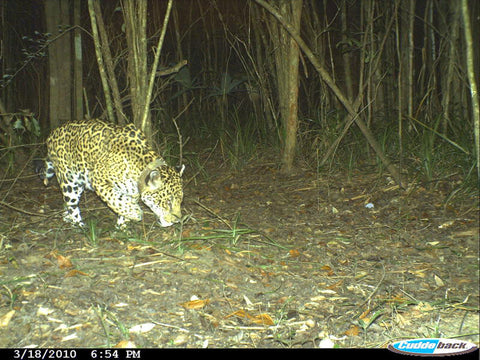
This particular project was headed by Biologist Verónica Quiroga. The project was located in the Chaco region of Argentina. The project was aimed at the Jaguar (Panthera onca), which is indigenous to this region. In Argentina, the Jaguar is considered endangered and their populations have gone down 85% (Click the link to read Verónica Quiroga's full 2008 Report).
Here are some pictures of the work team and their project -
Verónica Quiroga studying a GPS
The work team
Verónica studying game tracks

Leaf River Camera Trap

Base Camp
The great thing about Camera Traps is you never know what you are going to find!
Here are a few examples of their work -

|

|
| Leopardus pardalis
|
Puma concolor
|
|
|
|
|

|
|
Myrmecophaga tridactyla
|
Mazama Gouazoubyra
|
|
|
|
|

|

|
| Myrmecophaga tridactyla
|
Tolypeutes matacus
|
| |
| | |
|


We Value Your Privacy!
|
|