

Game Camera Battery Information
What Type of AA Battery Is Best For Use In Trail Cameras?
Which battery is best? Well, the most accurate answer is that no single battery reigns supreme in all situations. Different battery chemistries excel in some situations but pose challenges in others.
So, let's talk about the four main types of batteries, their characteristics, and why you might want to use one type over another.
Alkaline Batteries
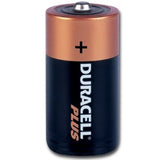
Alkaline batteries are widely available and inexpensive, but they have several drawbacks. They are shipped measuring about 1.5 volts, but their voltage drops immediately upon insertion.
As time passes, the voltage level continues to decrease proportionally to the time left in the field/number of photos taken. This proportional decrease is especially evident when you examine night photos taken by inexpensive infrared cameras. Photos taken early in the life cycle of an alkaline battery are bright and well illuminated. These early photos also represent the camera's maximum flash-range potential. However, with every passing day, each subsequent night photo is less illuminated. The process continues up until the point where night photos are pitch black and/or the camera shuts off due to low voltage. Our #1 customer service inquiry is:
"Why does my camera take black photos at night?"
99.9% of the time, failing alkaline batteries are to blame.
Cold temperatures adversely affect alkaline batteries.
Battery life is diminished, and alkaline batteries lose up to half their capacity in sub-freezing weather. This is why so many trail camera users discover long periods during which their camera didn't capture any photos, only to find it mysteriously started working again once the temperature rose.
Alkaline batteries can't handle power surges.
The power demands of some infrared trail cameras exceed what alkaline batteries can provide. Red-glow IR cameras draw relatively little current. However, No-glow IR trail cameras can draw up to 1000 mA when powering their invisible flash. Alkaline batteries often can not meet this power demand, and the camera either shuts down or produces night images/videos with no illumination.
Alkaline batteries are also prone to leaking acid which has claimed the life of many a device. Additionally, they are good for only 1 use and then find their way to the landfill. Most environmentally conscious people avoid the use of alkaline batteries whenever possible.
One redeeming quality of alkaline batteries is that they can operate at higher temperatures without performance loss. This offers many researchers an inexpensive alternative to NiMH rechargeable batteries, which suffer from reduced capacity in hot climates.
To summarize, alkaline batteries are cheap and available everywhere, but provide inconsistent power and don’t work well in the cold, not to mention they are extremely unreliable. They are the #1 source of "trail camera problems."
If you must use alkaline batteries, we recommend only using Energizer or Duracell. In our experience, most off-brand alkaline batteries have substantially less capacity and are very unreliable.
Lithium Batteries
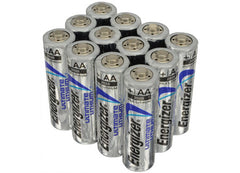
Lithium batteries offer several compelling benefits. To start, lithium batteries produce 1.6 volts/cell, or as we like to say “They run hot”. Just as decreasing voltage produces weaker flash characteristics, increased voltage can produce a stronger flash with brighter pictures and increased flash range in some cameras.
Due to their chemical makeup, lithium batteries are the least affected by any change in temperature, hot or cold. Their increased capacity gives them longer run times than the best rechargeable or alkaline cells. Additionally, single use lithium batteries weigh substantially less than alkaline or NIMH cells. This can be a huge advantage for backpacking into remote areas to manage cameras.
Until recently, we have been huge fans of single-use lithium batteries. Even though they were expensive, they were the most consistent power source we could find. Unfortunately, they have not only doubled in price; we have also documented an increasing number of defective cells. It is common to find one of our recently deployed cameras with new batteries dead. Further inspection reveals one bad cell has completely shut down the entire power supply after just a few days in the field. This is not isolated to our testing. Several of the manufacturers we represent as well as research institutions we supply have noticed the same occurrence. Additionally, single-use lithium batteries release gas during use. This gas produces a very strong & distinct smell that attracts the attention of some animals. The above factors have caused us to focus on renewable alternatives that offer cost savings and benefits to the environment.
Nickel Metal Hydride (NiMH) Rechargeable Batteries
Nickel Metal Hydride (NiMH) Rechargeable Batteries

Pros:
- Less expensive in the long run
- Longer battery life in winter months
- "Eco-friendly"
Cons:
- Adversely affected by hot weather
- Low voltage output
Fully charged, NiMH batteries produce about 1.4 volts. However, they quickly drop to a working level of 1.2 V, which they consistently maintain for the rest of the usage cycle. However, the 1.2 working voltage does present a problem for use in some cameras. Most cameras are designed around a 1.5 volt/cell scenario. It is very common for a camera to use 4 batteries, or essentially a 6-volt system (4 X 1.5volts).
Many of these 6-volt systems constantly monitor the voltage and automatically shut the camera off when the voltage dips to around the 5-volt level. With NiMH batteries providing just 1.2 volts/cell, they produce an aggregate voltage of only 4.8 volts. This makes Nimh batteries incompatible with some trail camera models.
Charging is Critical
We have learned that what you use to charge your batteries has now become just as important, if not more important, than how and when you charge your batteries. Most inexpensive chargers (think discount store again) charge batteries at a constant current (200 mA) for a set time (8 hours), regardless of how much capacity remains in the battery. This would be fine if all of your batteries were fully drained every time you placed them in the charger, but this isn't reality. Typically, when I run cameras I come back to the office with a box full of batteries and no idea how much capacity is left in each cell. Luckily, we use a smart charger with a microprocessor that individually monitors the charging of each cell based on the cell's remaining capacity. The smart charger brings each cell to a full charge (independent of the others) and then switches to a trickle charge for storage until it's removed from the charger. Conversely, cheap chargers apply the same amount of charge to all cells and often overcharge batteries. Batteries exposed to a greater level of charge overheat and lose a portion of their future capacity - some even fail immediately. To fully enjoy the benefits and efficiencies of NiMH batteries, please use a smart charger.
Put your batteries to use the instant they are removed from the charger
NiMH batteries begin to self-discharge immediately after removal from the charger, even if they aren't being used. Each cell loses about 0.5% of its capacity per day until it is fully depleted. To maximize battery life, plan trips to your scouting area and charge accordingly. When put into the field immediately, we get 2 - 2 1/2 months of battery life from our NiMH batteries.
Set realistic expectations for your batteries
Manufacturers of rechargeable camera batteries make claims of "Hundreds" if not "Thousands" of possible recharges. I'm sure this is possible when used in a high-energy device that requires daily charging. However, based on our experience, we expect somewhere between 3 and 5 years of field use from our NiMH batteries.
Avoid using NiMH batteries during periods of high heat
We've noticed a sharp decline in battery life when temperatures rise above 90 degrees. In fact, during a stretch of 100-degree days, we noticed batteries that normally lasted 10 weeks only surviving for a week or two. When NiMH batteries suffer, alkaline and lithium batteries perform great. We make a point to switch out our NiMH batteries with lithium batteries during the hottest months of the summer.
Lithium-ion (Li-ion) Rechargeable Batteries
Lithium Ion (Li-ion) Rechargeable Batteries

Lithium-ion (Li-ion) rechargeable batteries have become a common choice for a wide range of electronic devices, including trail cameras. They offer several advantages over other battery technologies, but also come with a few drawbacks.
Advantages of AA Rechargeable Lithium-Ion Batteries
-
High Energy Density: Li-ion batteries can store a significant amount of energy in a relatively small volume, making them ideal for devices where space and weight are concerns.
-
Long Cycle Life: Under optimal conditions, Li-ion batteries can be charged and discharged for hundreds to thousands of cycles before their capacity significantly diminishes.
-
Low Self-Discharge: Unlike some other rechargeable batteries, Li-ion batteries lose their charge relatively slowly when not in use.
-
No Memory Effect: Li-ion batteries do not require full discharge cycles to maintain their capacity, a problem faced by older nickel-cadmium batteries.
-
Consistent Voltage: The native voltage of a Li-ion cell is 3.7 volts. Left unmodified, these cells would not be compatible with devices that use standard AA batteries. However, Li-ion rechargeable AA cells have a microprocessor on the tip of the battery which reduces and regulates the voltage to exactly 1.5 volts throughout the entire lifecycle of the battery.
- No Smell- Unlike some lithium batteries that have a strong smell, these do not.
Disadvantages of Lithium-Ion Batteries
-
Hard to calculate remaining capacity: AA rechargeable Li-ion batteries produce exactly 1.5 volts throughout their entire life cycle and then abruptly die. As a result, devices are not able to calculate the remaining battery life. Trail camera users must keep track of the number of photos taken and swap out batteries accordingly.
-
Cost: Advanced manufacturing processes make rechargeable Li-ion batteries more expensive than some other types of batteries. However, the additional expense is usually recaptured in just 2-3 charges making subsequent use nearly free.
Conclusion Lithium-ion rechargeable batteries require a little more attention, but provide consistent, reliable power. Although expensive at first, these batteries pay for themselves after just a few charges.
Battery Life
Of all the tests we complete, Battery life is without a doubt the most complicated. With so many variables contributing to the ultimate outcome, it can become very confusing. The best way to start the discussion is to identify each variable we test, and then explain how that variable relates to other variables and ultimately determines the overall battery life of a particular scouting camera.
Current Draw (resting power consumption)
Every trail camera requires a certain amount of energy to keep it alive and alert waiting for the next animal to walk by. Resting power consumption values range from as little as .14 mW up to 2.74 mW or more. At Trailcampro we measure the resting current draw of every game camera we test and then compare it to the mWh capacity of the camera’s power supply (batteries). Simply defined, milliwatt hour capacity is the maximum load (expressed in milliwatts) that a battery can sustain for one hour. A great analogy to mWh capacity would be the volume of gasoline that a particular car’s gas tank is capable of holding. And just as we can calculate the range of any vehicle based on the size of its gas tank and corresponding mpg, we can also extrapolate the maximum number of days a camera can last in the field by dividing a trail camera’s resting current draw into the mWh capacity of its power supply. Please note I said “maximum” number of days because this calculation doesn’t consider other variables such as number of pictures taken, ratio of night vs. day photos, self-discharge rate of batteries, net power consumption used per each photo, etc, etc. However, for simplicity’s sake, we can calculate the total number of days a camera can last in the field without taking any pictures as follows:
Wh capacity/(Ws per day/3600) = number of days in the field before running out of battery power
Photo Power Consumption
From the instant a trail camera first detects motion a whole series of events take place while the system completes the process of capturing and storing a photo. This series of events varies in duration, scope, and intensity depending on the brand and model of game camera. Some of the more common activities include, but are not limited to:
• Sampling available light & adjusting exposure settings for optimum photo quality
• Taking a sample photo or two
• Charging the capacitor which powers the incandescent flash
• Diverting power to the infrared flash
• Accessing the storage device to prepare it for writing the photo to memory
• Capturing the photo
• Storing the photo to memory
• Accessing instructions from the firmware to determine how and when the next photo should be taken
All of the above functions require time and consume power. While some manufacturers complete these tasks with great efficiency, others struggle. Photo power consumption values range from just 140 milliamps for 1/2 second up to surges of over 1000 milliamps with increased power lasting well over 60 seconds. By meticulously measuring this data we can quantify the power required to process a photo in every camera we test. We can then calculate the maximum number of photos a scouting camera is capable of capturing on a single set of batteries. In addition, further computation provides us a quantifiable loss of time in the field each photo robs from the camera’s standby time in the field.
A real-life illustration combining resting current draw and photo power consumption:
Browning Defender Pro Scout Max HD
Battery Type 8 AA’s in series producing 3000 Mah @ 12 volts
Resting current draw .14 mW, Photo power consumption Day 31.3 Ws / Night 34.5 Ws Taking an average of 15 daytime and 15 nighttime photos every 24 hours, the user would have to replace 8 batteries every 6 months. Using Energizer Ultimate Lithium batteries ($3 each) would cost the user $144 over a cellular trail camera's anticipated life (3 years).
Tactacam Reveal Pro 3.0
Battery Type 12 AA’s (2 parallel groups of 6 cells) producing 6000 Mah @ 9 volts
Resting current draw 2.74 mW, Photo power consumption Day 70.1 Ws / Night 73.7 Ws Taking an average of 15 daytime and 15 nighttime photos every 24 hours, the user would have to replace 12 batteries every 2 months. Using Energizer Ultimate Lithium batteries ($3 each) would cost the user $648 over a cellular trail camera's anticipated life (3 years).
Conclusion
As you can see, the differences can be quite dramatic. These units are equivalently priced at purchase. However, when you factor in the cost of batteries throughout the camera’s useful life, differences in the cost of ownership can be dramatic. Energy efficiency should clearly play a significant role in your choice of a trail camera.
Shut off voltage (minimum level of voltage required to power camera)
Another item we test is “Shut Off” voltage. Simply put, a scouting camera’s shut off voltage is the minimum level of volts required to power the camera for normal operation. Anything less and the camera will shut off due to insufficient power. While rarely mentioned, this particular attribute becomes relevant in many ways. To fully understand, we must first explain how batteries perform throughout their lifecycle. The graph below illustrates how the voltage in different types of batteries decreases over their lifecycle.
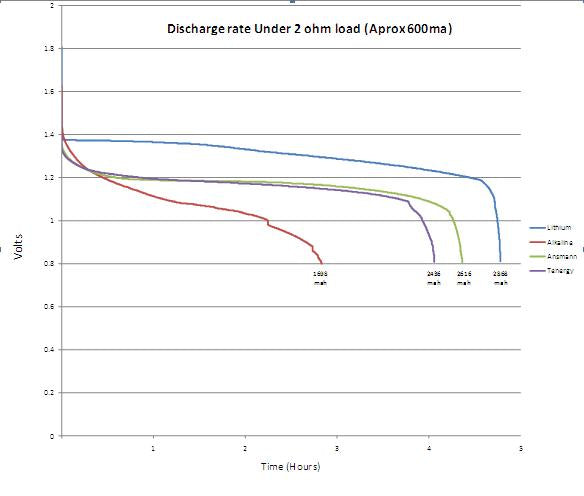
You’ll notice alkaline batteries start at 1.6 volts and then immediately begin a gradual decline throughout their life until they are “dead”. However, Lithium & Nimh batteries maintain a steady level of voltage (albeit different levels) throughout most their life and then completely die all at once at the end of their life. When combined with the shut off value of a particular scouting camera, the usage curve of each type of battery becomes important in two (2) key areas:
1. Some game cameras are incompatible with certain types of batteries due to their shut off values (minimum power requirement). Most camera manufacturers design their cameras using a 6 volt camera battery power supply (4 batteries at 1.5 volts each = 6 volts). Many of these same manufacturers also program in a shut off voltage of about 5 volts. It is this 5 volt shut off threshold which creates a problem for anyone wanting to use Nickel metal hydride (Nimh) rechargeable batteries. Nimh cells provide consistent power and aren’t affected by cold temperatures like alkaline batteries which can easily lose up to half of their capacity during sub freezing weather. They are also very economical given they can be used for hundreds of charging cycles. However, Nimh batteries have a working voltage of just 1.2 volts/cell or 4.8 volts aggregate when used in the typical trail camera. Unfortunately, anyone who owns a scouting camera with a shut off value above 4.8 volts can’t benefit from the advantages of Nimh batteries.
2. Some Trail Cameras are incapable of utilizing the full mah capacity each battery offers. Using the graph above from the previous example, you’ll notice the voltage in alkaline batteries dips to about 1.2 volts one-fifth of the way through its usage cycle. At this point the aggregate voltage in many game cameras has dropped below the shut-off threshold forcing the unit to shut off leaving the camera’s batteries with 80% of their capacity unused. Getting back to our automobile gas tank analogy, this would be equivalent to providing a 20-gallon tank with a fuel line that only reached down far enough to access the top 4 gallons. This issue only applies to the use of alkaline batteries. Lithium cells provide adequate voltage throughout their entire life cycle and Nimh batteries shouldn’t be used in any camera with a high shut-off voltage.
Conclusion
As you can see, the variables involved with battery life (many of which are not constant) make its calculation anything but an exact science. However, what we can determine with great accuracy is the power consumption associated with each model. We can then plug those figures into a formula and produce battery life estimates. While these estimates may not be exact for each model, the relationship or ranking of one model relative to another is. So, while we cannot say the battery life of a Browning Defender Pro Scout Max HD is 195 days, we can say that a Browning Defender Pro Scout Max HD will last about 3 times as long as a Tactacam Reveal Pro on a single set of batteries.
Shop Cellular Trail Cameras


82/100


81/100


85/100


85/100


93/100


79/100

79/100


83/100

83/100


81/100


89/100


88/100


85/100
Security Trail Cameras


86/100


85/100


85/100


85/100


85/100


85/100


87/100


93/100

93/100


78/100


91/100


91/100


91/100
Batteries For Trail Cameras


Declare withdrawal
Please fill out the following form to declare your withdrawal from the contract.
