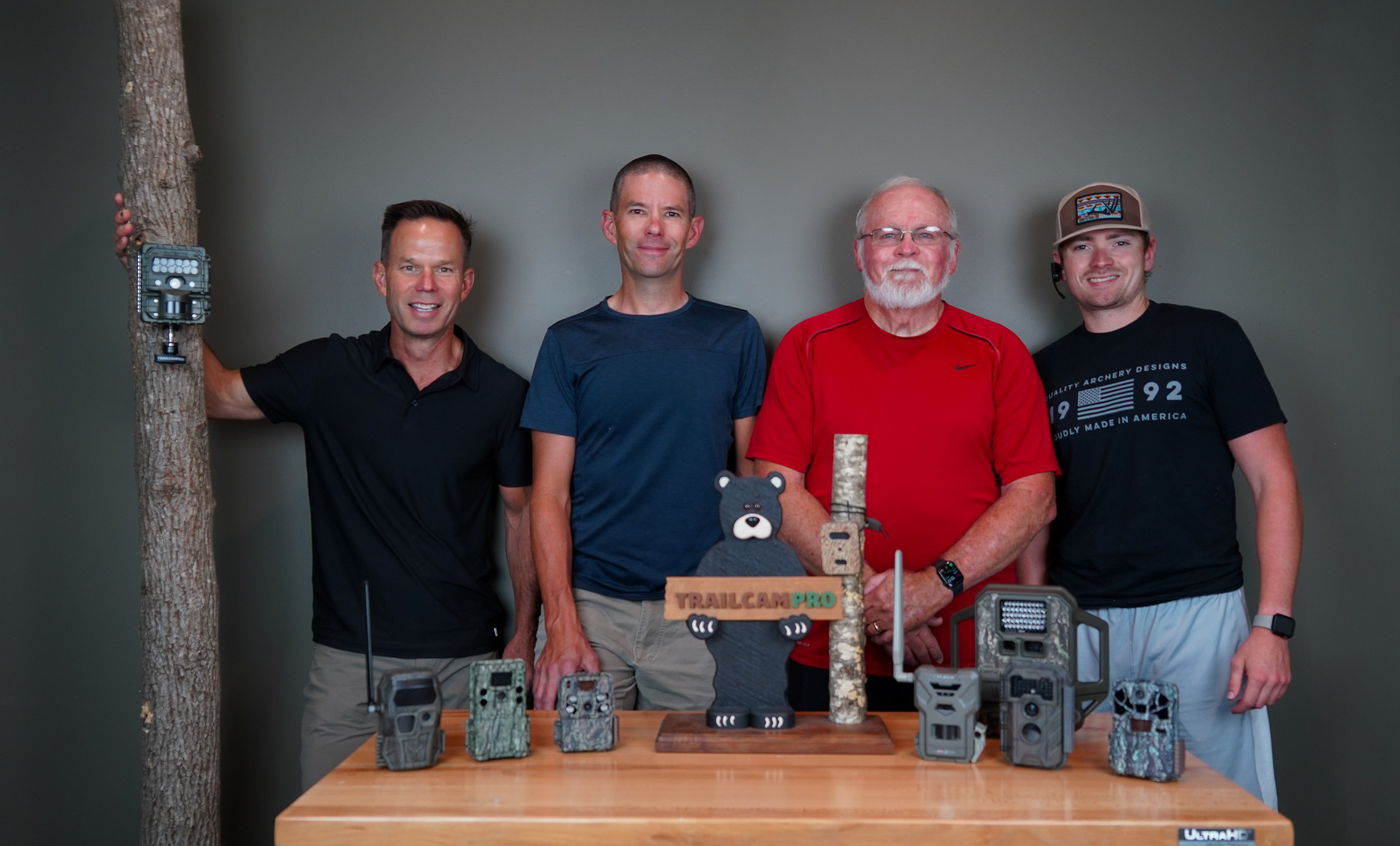

2026 Trailcampro Shootout
Each year, Trailcampro conducts three performance tests to compare the latest camera models. These tests include the Detection Shootout, which assesses how well the cameras are triggered by thermal detection; the Flash Range Shootout, which evaluates the infrared flash capability; and the Transmission Shootout, which measures the speed at which cameras send photos to a mobile device. Find this years results below!
WINNERS:
Non-Cellular Detection: Alpha Cam 4K
Cellular Detection: Moultrie Edge 3 Pro
Flash Range Overall: GardePro T6LRW
Flash Range Non-Cellular: GardePro T5NG Pro
Flash Range Cellular: Spypoint Flex Dark
Transmission: Reconyx HyperFire 4K Surveillance LPC
Detection Shootout
Method for Non-Cellular Models
For years the Trailcampro Trail Camera Shootout has been designed to test the combination of a camera's trigger speed, recovery time and detection range. In this test, each camera is awarded a point for each full picture (greater than 60% of the body) of the test subject captured on each pass. When completing the trail camera shootout comparison, we also record empty and partial pictures to compute an efficiency rating for each camera.
 |

|
Overall Score: The total number of pictures the camera took with the person completely inside the field of view.
Efficiency Rating: The efficiency rating is simply the percentage of pictures a camera captured with a valid image (60% or greater of the subject). While this has no bearing on a camera's ranking, the efficiency rating quantifies how many empty photos you might have to click through if you purchase a particular model. We prefer models that only take photos of animals. False triggers waste memory space, eat batteries and cost the user extra time clicking through empty frames.
Detection Range: The attached spreadsheet shows the max distance each camera was able to detect motion and capture an image. Cameras that detect motion at greater distances generally score better. Why is this important? In this test several cameras only captured images out to 50' while other cameras detected motion out past 100'. Conventional thinking would suggest a camera that detects twice as far would capture twice as many photos, Right? It's so much more. Most trail cameras have a detection angle of roughly 42 degrees. This means as a camera detects at longer distances, it also detects over a wider area. In this case a camera which detects out to 100' doesn't just cover twice the area, it covers 4X the area:
50' range @ 42 degrees = 915 sq ft
100' range @ 42 degrees = 3663 sq ft
As a trail camera's detection range increases, its ability to capture activity increases exponentially. Cameras with longer detection ranges cover more area and offer better value.
Recovery Time: Recovery time is the amount of time required for a trail camera to detect motion, capture a photo, re-arm itself and trigger a second time. Cameras with faster recovery times capture more photos every time an animal visits a camera site. Benefits include multiple angles of each animal including several perspectives to estimate size or identify a particular animal. Before recovery time became a KPI (Key Performance Indicator) early models were only capable of capturing 1 photo every 60 seconds. The classic missed opportunity created by this limitation was a buck chasing a doe. The doe triggers the camera and the buck walks by undetected while the camera is rearming. Fortunately, the industry has evolved and most cameras have recovery times suitable for any situation. The number of photos captured on each pass is directly related to a camera's recovery time. Cameras with fast recovery times perform well in the shootout. Cameras with fast recovery times and long detection ranges win the shootout. Incidentally, cameras with both these attributes also capture more data and offer better value.


Trailcampro Flash Range Shootout

Trail camera Flash Range has a tremendous impact on the effectiveness of any trail camera. Below we’ll touch on both the internal & external variables and explain why we test the way we do. Since the majority of all trail cameras use an infrared flash, the items referenced in this flash camera test will only pertain to IR flash cameras.
Internal Variables
- Type of infrared LEDs - Infrared emitters used in trail cameras produce light wavelengths anywhere from 700 nanometers up to 940 nanometers with the most common being 850 (red glow) and 940 (no glow). As IR wavelength increases, it becomes more difficult for animals to visibly detect. It is believed wavelengths above 900nm produce light which is invisible to the human eye. However, all animals (humans included) are not genetically equivalent. Certain members of our staff are routinely able to see 940 no glow flashes that other members can't. What does hold true is higher NM flashes typically produce less illumination and/or use more power. Historically, red glow cameras in our shootout have outperformed their no glow counterparts.
- # of infrared LEDs– There is a direct correlation with the number of LED's and flash range. Cameras which have a larger number of infrared LED's in their flash will almost always have more illumination than cameras with fewer LEDs. One exception is the recent introduction of high intensity LEDs. Some cameras with just 4 or 5 high intensity LEDs produce more illumination than traditional arrays with 40 LEDs.
- Energy Used– Think of your hand-held flashlight when it’s low on batteries vs. the strength of its beam with a fresh set of batteries. Flash strength and range of illumination are directly influenced by the amount of power sent to a flash. At the expense of battery life, some cameras send more power to their flash than others. As a result, those cameras can have more illumination than other cameras with the same number of LEDs.
- Exposure time– This is an area many camera manufacturers have manipulated in recent years. At the expense of clarity, trail camera flash range can be extended by increasing exposure time. Essentially, the longer a shutter is left open, the farther out a flash will illuminate. Unfortunately, any movement during the time the shutter is open produces blurry photos. This is why we always provide a photo with a subject moving through the field of view next to each flash range photo.
External Variables
- Moonlight– The phase of the moon and the intensity of its light greatly influences flash range and illumination. A night photo taken under a full moon and clear sky can exhibit twice the flash range and illumination of a photo taken under an overcast sky with a crescent moon.
- Cloud cover– Regardless of moonlight, cloud cover influences flash range as well.
- Tree canopy– A dense tree canopy can completely negate any flash enhancing benefits of a full moon or clear sky.
We always perform our trail camera flash range test for all models tested on the same night, under the same moon and sky, in the exact same setting, under the same tree canopy with a fresh set of batteries. Please be very careful when comparing nighttime photos as it is very easy to manipulate results.
Equipment Issues
The size and type monitor one uses as well as the angle from which it is viewed will influence the perceived flash distance of a camera. In our evaluation, we use our largest and best monitor and tilt it at numerous angles to get the best range for each photo. We make every attempt to assess photos from their best perspective.
Criteria we used to rank photos
I want to first say this is one of the few tests we perform where human subjectivity comes into play. Having said this, we ranked photos using the following factors with priority based on the order they appear.
- Overall illumination across the entire field of view out to 130 feet
- Clarity, Contrast & Resolution
- Presence of "Hot Spots" or areas of overexposure
We have also included photos to see how effective the cameras are in detecting motion blur in addition to ranking the flash range.
In the end, different individuals may value different attributes and characteristics of photos. If nothing else, we have provided a sampling from most every camera on the market taken under very controlled and fair conditions for you to make your own evaluation. Scroll down to see our trail camera flash range comparison test for yourself.
Combined Red Glow, Low Glow & No Glow Infrared (Cellular & Non-Cellular)
- GardePro T6LRW (WiFi)
 |
 |
2. GardePro T5NG Pro (Non-Cellular)
 |
 |
3. Alpha Cam Plus (Non-Cellular)
 |
 |
4. Alpha Cam Premium (Non-Cellular)

|
 |
5. Spypoint Flex Dark (Cellular)

|
 |
6. Spypoint Flex S Dark (Cellular)

|
 |
7. Spypoint Force 4K (Non-Cellular)
 |
 |
8. Browning Strike Force Pro X 1080 (Non-Cellular)
 |
 |
9. Browning Defender Pro Scout Max HD Direct Video (Cellular)

|
 |
10. Ridgetec Lookout X (Cellular)

|
 |
11. WiseEye DC-2 (Cellular)

|
 |
12. Alpha Cam 4K Dual Lens (Non-Cellular)
 |
 |
13. Browning Dark Ops DCL Nano (Non-Cellular)
 |
 |
14. Stealth Cam Fusion Max 3.0 (Cellular)

|
 |
15. Browning Strike Force DCL Nano (Non-Cellular)

|
 |
16. Spypoint Force Pro S 2.0 (Non-Cellular)

|
 |
17. Tactacam Reveal Ultra (Cellular)

|
 |
18. Alpha Cam Dual Lens 1080 (Non-Cellular)

|
 |
19. Browning Dark Ops FHDR40 (Non-Cellular)

|
 |
20. Browning Defender Pro Scout Max HD Solar (Cellular)

|
 |
21. Browning Recon Force Elite HP5 Ultra (Non-Cellular)

|
 |
22. Browning Strike Force FHDR40 (Non-Cellular)

|
 |
23. Bushnell S-4K (Non-Cellular)

|
 |
24. Spartan GoCam2 M (Cellular)
 |
 |
25. Covert Interceptor (Cellular)

|
 |
26. Tasco (Non-Cellular)

|
 |
27. Stealth Cam Spectre 4K (Cellular)

|
 |
28. Stealth Cam Revolver 3.0 (Cellular)
 |
 |
29. Yellowstone.ai (Cellular)
 |
 |
30. Browning Spec Ops Elite HP5 Ultra (Non-Cellular)
 |
 |
31. Bushnell DS4K (Non-Cellular)

|
 |
32. Spartan GoLive 3M (Cellular)

|
 |
33. Spypoint Flex M (Cellular)
 |
 |
34. Stealth Cam Deceptor Max 3.0 (Cellular)
 |
 |
35. Vosker VKX (Cellular)

|
 |
36. Reconyx HF4K (Cellular)
 |
 |
37. Reconyx HS4KC (Cellular)

|
 |
38. Reconyx HS4K (Non-Cellular)

|
 |
39. Yellowstone.ai Wide Lens (Cellular)
 |
 |
40. KJK (Non-Cellular)
 |
 |
Trailcampro Transmission Shootout
In 2024, we introduced an all new shootout called the "Transmission Shootout". This unique test allows us to evaluate the speed of cellular trail cameras and has evolved into including WiFi trail cameras in a real-world scenario.
In this shootout, we measure how quickly each cellular camera can transmit a photo from the moment it's triggered to when a notification appears on your mobile device. To ensure accuracy, each camera is given three transmission attempts, and we calculate the average time to determine the rankings.
We've set up a controlled testing environment where all cameras are connected to a device that precisely records the transmission time, starting when the photo is taken and stopping upon receiving a notification. To maintain fair comparisons, all cameras are tested at the same location and are done one after the other.
Below, you will find how many seconds the cameras took to transmit one photo until the phone received a notification.

Shop Cellular Trail Cameras


82/100


88/100


85/100


85/100


87/100


74/100


85/100


84/100


84/100


71/100


84/100


84/100


72/100


72/100
Security Trail Cameras


86/100
85/100


91/100


85/100


85/100


85/100


85/100


87/100


93/100


91/100


78/100


91/100


93/100
Batteries For Trail Cameras


Declare withdrawal
Please fill out the following form to declare your withdrawal from the contract.
